Archivo

Diarios/Series · 2025

Buendía Pereyra Iraola

1

El hombre que soñó con poblar la llanura

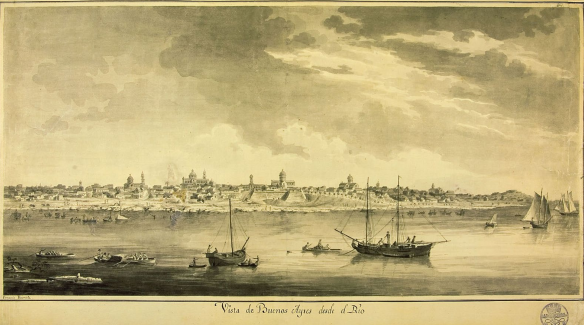
Tinta y aguada sepia titulada “Vista de Buenos Ayres desde el río” (1794) por Fernando Brambila

Mucho antes de que se alzaran los álamos sobre el campo polvoriento de Juárez, cuando la tierra todavía se abría en grietas anchas bajo el sol de diciembre y los caranchos planeaban en silencio sobre el río, Leonardo Buendía Pereyra de Castro llegó a Buenos Aires con el mar salado pegado en las suelas de sus botas.

El barco había atracado una mañana clara del año 1767, cuando el sol apenas asomaba como un brasero opaco sobre las aguas del río ancho y espeso que se extendía, rumoroso, hasta confundirse con las nubes bajas del horizonte. El puerto despertaba con un concierto de ruidos que se entremezclaban sin descanso: el chirrido de las roldanas al subir y bajar toneles, el quejido de las cuerdas tensas, el crujir de la madera vieja de las planchadas empapadas en sal, y los gritos de los marineros que se mezclaban con el llanto de los niños y las niñas que abrazaban a sus madres mientras esperaban que los bueyes cargaran las mercaderías.

Los negros cargadores se movían como sombras rápidas bajo el sol que ya quemaba, con las moscas pegadas a sus cuerpos brillantes de sudor, llevando sobre los hombros los cueros húmedos que chorreaban un olor acre, o los toneles de vino que goteaban entre las rendijas de la madera. Las balandras, cargadas de cueros y sebo, iban y venían desde los barcos mayores, donde marineros descalzos gritaban órdenes en castellano y en portugués, y entre los botes a remo se escuchaban las risas de los pescadores que traían en sus redes corvinas plateadas y sábalos brillantes, todavía vivos, que saltaban con un último estremecimiento antes de ser arrojados en canastos de mimbre.

Leonardo descendió por la planchada con paso firme, con un sombrero de ala ancha que ocultaba su rostro curtido por los vientos del Atlántico, y se detuvo un instante a contemplar aquel río color de tierra donde se mecían las embarcaciones ancladas en la costa: algunas, con velas recogidas, esperaban la orden de descargar sus toneles de sal, otras estaban ya rodeadas de hombres que llenaban carretas con bolsas de harina, de tasajo o de cuero crudo que iba impregnando el aire con su olor agrio.

Llevaba consigo un arcón de madera con bisagras de hierro, pesado como un secreto, donde guardaba un rosario de cuentas negras, una camisa de lino con olor a agua de lluvia, una daga de hoja corta que había heredado de su abuelo, y una libreta de tapas de cuero donde anotaba con letra pequeña y cuidadosa los nombres de quienes le debían favores y pesos fuertes. En sus bolsillos, crujían al caminar las cartas de recomendación con sellos lacrados que brillaban al sol, dirigidas a comerciantes que ya calculaban sus ganancias con el pulso rápido del nuevo virreinato, y a sacerdotes que ofrecían bendiciones a cambio de una caja de vino de Cádiz o de un paquete de sal traído en las bodegas de las naves.

Buenos Aires olía a cuero húmedo, a estiércol de los bueyes que esperaban junto a las carretas hundidas en el barro, a salitre de redes recién sacadas del río, y a sudor de hombres y mujeres que trabajaban sin descanso. Las casas bajas de adobe, pintadas con cal que se desprendía en escamas tras cada lluvia, formaban un caserío compacto donde se alzaban, como custodios de piedra, los campanarios de las iglesias que marcaban las horas con sus campanas roncas, avisando el paso de la vida y de la muerte en cada esquina. La cúpula de la catedral se distinguía en el horizonte polvoriento, junto con las torres de Santo Domingo y San Francisco, mientras el Cabildo, con sus arcos y corredores de sombra, guardaba en sus salas el murmullo de los acuerdos y las discusiones que se cocinaban entre paredes húmedas.

Leonardo se detuvo frente al hospital de los Betlemitas, donde hombres de rostro pálido y mujeres de mirada cansada esperaban un catre y un cuenco de caldo ralo, mientras un fraile recogía limosnas con una sonrisa serena. Más allá, en las esquinas, los vendedores ambulantes agitaban campanas para anunciar pescado fresco, velas de sebo que se consumían en una sola noche, sogas, o pequeños panes que se desmigajaban con el tacto, y un aguatero gritaba con voz de trueno ofreciendo agua traída de los pozos, en barriles que goteaban sobre el polvo.

La ciudad se extendía hacia el Retiro, que aún era un paraje agreste con árboles que se inclinaban con el viento que llegaba del río, donde algunos hombres y mujeres se reunían a beber mate en cueros extendidos sobre el pasto, mientras miraban pasar las nubes lentas del verano. Los soldados de la novena compañía de milicias de caballería se formaban en la plaza mayor, donde los tambores retumbaban bajo el sol, y los caballos relinchaban con ansias de salir al galope, mientras don Felipe Filiberto de Arguibel acomodaba su uniforme con la parsimonia de quien conoce el precio de cada botón dorado, de cada franja de galón, de cada montura de cuero curtido con manos de negros en los patios de las curtiembres.

Leonardo lo observó desde la sombra de un alero, mientras tachaba su nombre de la libreta de tapas de cuero con el mismo cuidado con que se borra un recuerdo que ya no se necesita. Don Felipe, con su porte de caudillo de puerto, dominaba con la mirada a los comerciantes que le juraban lealtad entre copas de vino oscuro, mientras los barcos esperaban su gesto para descargar su mercancía o quedar varados bajo el sol ardiente, con las velas flojas y las bodegas llenas del olor pesado del tasajo.

El río, mientras tanto, seguía latiendo con el pulso de la ciudad: balandras mercantes, botes de pescadores, barcazas de carga, y pequeñas embarcaciones que traían y llevaban cartas, cueros, vino, harina y sueños de fortuna, en un ir y venir constante, con el agua espesa golpeando los costados de las naves. Los marineros y las marineras cantaban canciones de Cádiz y de Galicia, mientras lanzaban las redes al agua o aseguraban las cuerdas con nudos que olían a sal y a algas podridas.

Era un Buenos Aires de barro y de bronce, de rezos y de cuchilladas en las esquinas polvorientas, de mujeres y de hombres que vendían su fuerza en los muelles y de comerciantes que contaban sus monedas detrás de cortinas de lino, mientras el sol encendía las cúpulas de las iglesias y el campanario de Santo Domingo se elevaba como un faro de piedra sobre el caserío de techos bajos.

Leonardo respiró aquel aire denso y cálido, sintió el murmullo de las olas que rompían contra los pilotes de madera, el olor a cuero y a sal que se pegaba en la piel, y el bullicio de una ciudad que latía con una energía que parecía provenir del mismo río que la alimentaba. Sabía que en aquel lugar, entre el barro y la brisa salada, entre los rezos de las campanas y las promesas de las cartas que guardaba en su bolsillo, comenzaba el verdadero viaje de su vida.
2

Chapter I: View of the River. Notes from the Deck

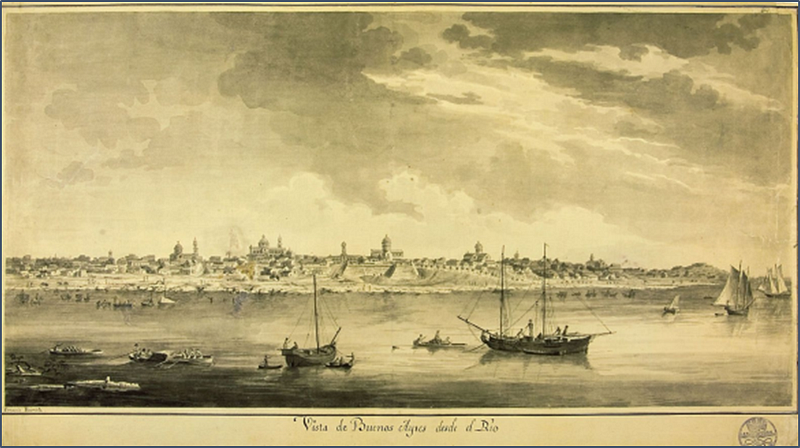
‘Vista de Buenos Aires desde el Río’ by Brambila, c. 1794

Long before the poplar trees rose over the dusty lands that would later belong to the Partido de Benito Juárez, when the pampas of Buenos Aires still lay unfenced and bare, cracked under the fury of the sun and circled by caranchos gliding through the hot air above the brown waters of the Río de la Plata, a man caught his first glimpse of the faint silhouette of Buenos Aires. Leonardo Buendía Pereyra de Castro — newly arrived from across the Atlantic, a man shaped by another geography, another language, another rhythm — stood on the deck of a ship anchored not far from the port. The slanted morning light, softened by the sweet vapors of the estuary, bathed his figure, outlined between barrels of salt and wine. The brim of his hat shaded his weathered face, and his eyes followed the jagged line of the horizon.

The city, still asleep, revealed itself as a smudge of earth between water and sky. It was not, as he had imagined through maps or merchants’ tales, a majestic capital, but a scattered hamlet — a cluster of low rooftops and adobe walls, punctuated here and there by towers and domes that barely rose above the plain. The image evoked, almost involuntarily, those port city views Fernando Brambila had begun to sketch on behalf of the imperial court: cities seen from the river, fanned open like geographical scrolls where art and cartography met.

Small coastal boats rocked gently in rhythm with the breeze blowing from deep inland. The muddy water reflected, in broken fragments, the sails, the oars, and the shifting silhouettes of bodies at work. On the riverbanks, barges unloaded hides, tallow, and fresh fish. The port resounded with a polyphonic murmur: Castilian with a Basque accent, overseas Portuguese, and torn fragments of African languages — echoes of slavery — mingled with the groan of wet ropes and the creaking of timber. Each sound struck Leonardo as if it came from a land that, though still unknown to him, was already claiming him.

The vessel that had carried him from Europe remained behind, like a colossal shadow anchoring the scene. Small boats detached from it, seeking a place to dock amid the shallows and mud. With him he carried a heavy trunk, its hinges rusted, filled with the remnants of a former life: a family dagger, a black rosary, a shirt that still smelled of home fires, and a battered notebook where he had jotted down names, debts, and unfulfilled promises.

From his vantage point — nearly identical to one Brambila might have chosen for a panoramic sketch — Leonardo perceived the port as a living organism: shirtless Black laborers, their skin gleaming with sweat, unloaded barrels trailing streams of wine. A cart, dragged by snorting oxen, pushed forward through the muck, while two men leaned into the load to keep it from tipping into the marshes.

He could still feel the ocean’s pulse in his bones — a lingering vibration. But the Río de la Plata received him with a different texture: not the violent jolt of waves, but a thick, maternal density that invited both prayer and risk. Leonardo could not help but think that this city of eleven thousand souls, plotted by measuring cord, was more than an imperial outpost. It was a stage under tension, an ambiguous promise.

Aboard the small boat ferrying him to shore, he felt the crackle of the letters of introduction in his pocket — sealed with wax, addressed to merchants and clergymen. They were his symbolic passport into a web of ties that hovered between blessing and betrayal. He carried more than paper; he brought a disposition, a will to inscribe himself into this new world through name, debt, and memory.

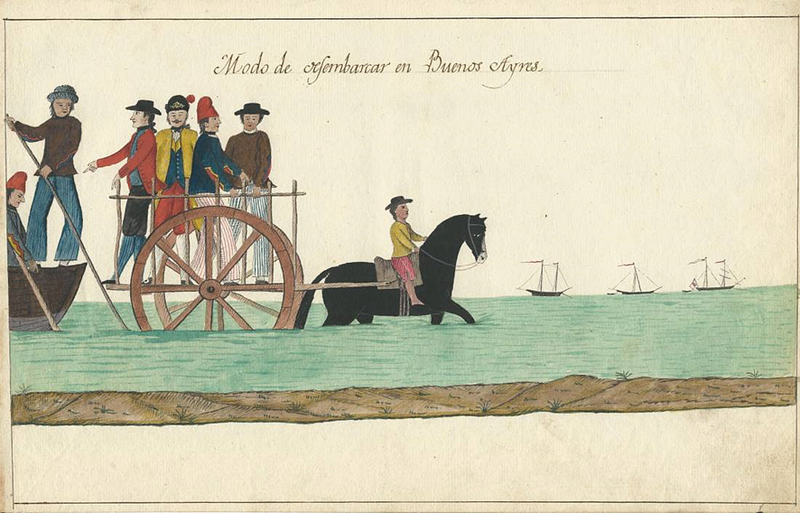
When the boat finally ran aground on the low shoreline, a few horses dragged it to firmer land. Leonardo disembarked with his trunk, boots sinking into thick mud. Before him, the first dirt streets stretched inland. Dogs slept under carts. Women draped in mantillas moved silently toward the chapels. At that moment, he understood that the true landing was not physical but mental: the city had already entered him, like an idea slowly overtaking the mind.

From his height, with the breeze brushing his brow, he took mental note of the city’s still-undefined contours. A line of land broken by domes — that was the first shape to strike the eye. Not drawn with a pencil, but with memory. Buenos Aires offered itself as a secret, a shape veiled in mist.

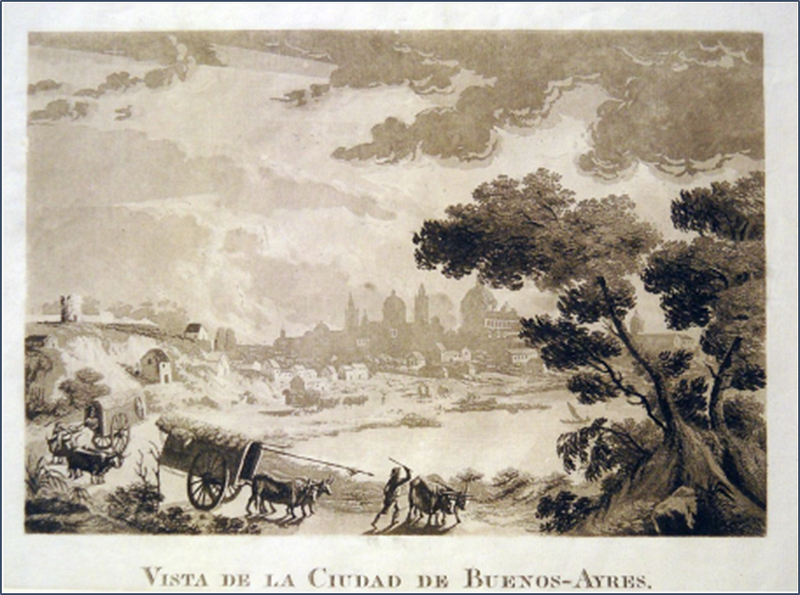
‘Vista de la ciudad de Buenos-Ayres’ by Brambila, c. 1794

The towers of Santo Domingo seemed to hold up the sky. Below them, tiled roofs nestled among the greenery of the orchards. The winding port revealed its own choreography: bodies unloading, straining, bending, enduring. Leonardo Buendía took note. He knew this city was neither a promise nor a refuge — it was a game board. And he had brought the cards to play.

The city, still wrapped in the haze of dawn, was beginning to stir. Sails slackened in the breeze. Voices grew sharper. Leonardo passed through the guard posts of the fort, leaving the echoes of the port behind. At his back lay the green fields he had crossed. Now he faced a city, just twenty-two blocks wide, but brimming with the world: muddy streets that trapped carts when it rained, where mass was suspended due to flooding, and where dust stung the eyes on sunny days. Buenos Aires was not a center, but a junction — of roads, of interests, of languages, of distrusts. It was a city woven by hands from far away — like his — and by those already shaped by mud, leather, and salt.

No recognizable nobility ruled here. Power shifted constantly among rhetorically gifted clergymen and merchants who amassed prestige through trade. It was a land of trades and gardens, of adobe walls shielding fruit trees, of uneven patios where grapevines hung. Women, with steady hands, sewed without tailors. In the kitchens, salt was dearer than bread. In the pens, cattle were slaughtered for their hides, which traveled along secret routes to distant markets. The rest — the waste — was left to dogs and rats, who thrived in the shadows of commerce, just like some merchants along La Merced Street.

Leonardo observed with the eyes of an apprentice. He listened to the murmured conversations in the taverns — talk of French cloth, unsealed liquors, and sweetened salt. He listened to fandangos played at dusk by young girls who, at sunrise, would chant Latin litanies. Buenos Aires was a tapestry of prayers and bargains, of vows and façades. In that thick air, heavy with dry thistle, spoiled meat, and salted nets, he understood he had not come to grow old — he had come to weave. Each step in the mud could leave a mark. Leonardo understood, as he walked, that knowing the streets was not enough — one had to read them. For in every crooked cobblestone, in every darkened entryway, the unwritten rules of a colonial society were encoded. Where a wall showed signs of dampness, one could guess a newly arrived merchant lived within; where a hammer clinked without pause, there was likely a mulatto cobbler at work. The city spoke, but it demanded a discerning ear and a trained eye to grasp its inflections.

With his wooden trunk, his rosary pulsing in his pocket, and a notebook where each name was either a promise or a warning, Leonardo began to walk. He had brought no title, no family crest — but he knew that with cunning and persistence, one day, seals and signatures might carve his name into the material memory of these lands.

3

Chapter II: Limewashed Streets and Bronze Bells

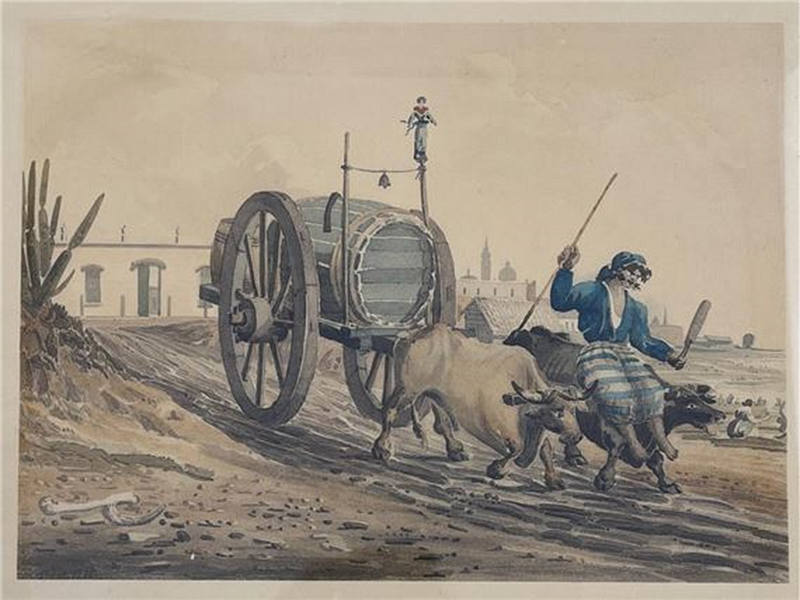
Emeric Essex Vidal “Water cart”

Once on solid ground, after wading through the thick mud of the riverside, Leonardo Buendía Pereyra de Castro began to make his way into the city. His steps were slow, almost reverent, as though each footfall demanded the right to belong. The first thing that caught his attention was the austere presence of the Bethlemite hospital. Its limewashed walls, weathered and flaking, barely withstood the persistent dampness of the estuary. Outside its half-open gates, gaunt-faced men and dull-eyed women waited like shipwrecked souls on dry land, hoping for a cot and a bowl of thin broth. A friar moved among them with timeless patience, collecting alms with a smile as serene as it was ancient — a gesture that seemed to emerge from centuries past.

All around him, the city unfolded with uneven vitality — a mix of dust, devotion, and commerce. Buenos Aires was not a cohesive whole, but a fragmented collection of scenes, of bodies in motion, of trades bound to the pulse of the day and the shifting demands of the port. From the corner of an unnamed street, Leonardo observed what could well have been a vignette by the English painter Emeric Essex Vidal: an ox-drawn cart with oversized wheels and a creaking groan descended a clay street, bearing a wooden barrel damp with leaking water. The water vendor — a broad man, his face darkened by sun and labor — held a stick in one hand while guiding the tired steps of the animals with the other. Dangling from the axle was a small figure, perhaps made of cloth or carved wood — a talisman of sorts, a silent act of superstition or everyday protection, a trace of popular spirituality that found no place on official altars.

The barrel, perched high upon the cart, had a clear purpose: to carry the murky water of the Río de la Plata and distribute it, drop by drop, throughout the city. It was not clean water — Leonardo knew that — but it was water nonetheless. It was life. It was a commodity. And like all commodities, it was offered up with a strong voice, a repeated cry, a learned theatricality. The water vendor — like many other urban tradesmen — was not merely delivering a good; he was performing a role, occupying a sonic space in the city’s collective imagination. His voice joined the street chorus: sellers of tallow candles that barely lit the night, bread rolls that crumbled at the touch, hemp ropes coiled like serpents, and fishermen offering shad still twitching from the dawn’s catch.

Each of these urban figures, Leonardo noted silently, composed a ceaseless choreography, a grid of exchanges between the essential and the barely sufficient, between survival and waiting. The water vendor, in particular, struck him as emblematic — a symbol of a city still without public fountains or reliable pipes, where distribution of the most basic resource depended on animal strength and manual labor. Yet the act of fetching river water and carrying it through dusty streets connected — silently but effectively — with the way Buenos Aires sustained and organized itself.

The scene was not merely picturesque; it was structural. In that leaking barrel atop the oxen’s backs, Leonardo saw condensed the precariousness and ingenuity, the need and the will to endure. The city narrated itself in such gestures. Its everyday history was not inscribed in palaces or decrees, but in these repeated scenes, these minor trades that, when observed closely, revealed the hidden framework of a social world in the making.

The low houses, built of adobe, formed a compact cluster. Their walls were coated with lime that flaked off after each rain. They were simple, functional constructions, resilient if unadorned — their monotony broken only by the vertical interruption of temples. The bell towers of Santo Domingo, San Francisco, and the Cathedral marked the rhythm of hours and labor with their bronze chimes — pacing the lives and bodies of a city where death and life greeted each other on every corner. The Cabildo, with its shaded arches, guarded in its damp chambers the half-whispered words of agreements, disputes, oaths, and silences. There, beneath colonial clay tiles, decisions were made whose effects reached beyond the city: into distant ranches, minor ports, and frontier taverns. On the uneven cobblestones of Santo Domingo Street, some children pulled a makeshift cart while an elderly Black woman watched them from a doorway. The African presence was not marginal — it was foundational. Leonardo sensed it at once: Black bodies were a visible and active part of the urban economy. From the washerwomen singing in the courtyards to the enslaved dockworkers at the port, it was they who sustained the city’s everyday architecture. The colonial order, no matter how piously it cloaked itself, was built on forced labor and constant surveillance.

Leonardo’s gaze rose from the dusty streets toward the distant horizon, where — just barely veiled by a luminous haze — he could see the Retiro district, still wild and untamed. There, the city gave way to ravines, grasslands, and trees bent by the unrelenting wind from the river. It was a threshold space — neither fully urban nor completely rural, not yet settled, but no longer untouched. On mild afternoons, men and women gathered on wool blankets or directly on the grass, forming quiet social circles that held together even in silence. They shared bitter mate in worn gourds, passing it hand to hand, with a blackened kettle warming over the embers. Words were few and murmured, as if measured — aware of their cost. Smugglers’ routes were discussed, vague news from Upper Peru, or the condition of cattle driven in from the pampas.

In that Buenos Aires — more village than city — on the frontier where Spanish civilization tangled with the Río de la Plata’s geography, Leonardo realized the soul of the place did not dwell solely in its buildings or plazas, but in these everyday gestures: the sip of mate, the wait for a boat, the discreet conversation at the close of day. Everything was trafficked there: Brazilian sugar, Paraguayan tobacco, European textiles, unregistered spirits — even gunpowder hidden in carefully disguised glass jars. Merchants negotiated in hushed tones, weighing words as if they were coins. Every deal was a gamble for survival in a city where wealth and ruin were separated by a single shipment, a single signature, a single outbreak.

In the main square, the drums beat a more formal rhythm. Here, the city remembered its military character, its role as a guarded frontier. The Ninth Cavalry Militia Company formed with inconsistent yet stubborn discipline, while the horses snorted, eager to move. At the center stood Don Felipe Filiberto de Arguibel, a man of measured presence, a harbor caudillo whose mere posture seemed to regulate the flow of bodies and goods. Arguibel adjusted his uniform with the calm of one who knows each golden button, each embroidered braid, each leather strap had been produced by enslaved hands in the tanning yards. Leonardo watched him from under a shaded eave. It was not the first time he saw him — but it would be the last time he would need him. He opened his worn notebook and, with a steady hand, crossed out his name. As if erasing a debt or burying a memory.

Don Felipe ruled the merchants with his gaze, courted by their smiles and cellar invitations. They knew his signature could free a shipment or condemn it to rot on the docks. At his nod, the warehouses — filled with jerked beef and liquor — could be emptied into eager hands or left, for days, fermenting under the heavy sun. Buenos Aires revealed itself to Leonardo as a rough, pulsing fabric. A city of mud and bronze, where church bells rang above blades drawn on street corners; where men and women sold their strength on the docks; where merchants, behind linen curtains, counted coins that would determine the fate of families. Above all, it was a city that beat with its own energy, fed by the same river that touched and sometimes overwhelmed it.

He breathed in the warm, dense air. He heard again the murmuring water lapping against the wooden pilings. He caught the lingering smell of dung, of dried fish, of freshly tanned leather. And he knew, without need for outward confirmation, that something more than a stay had begun — a life’s journey, a slow transformation, a struggle. Amid the tolling bells above the domes, the mud clinging to his boots, and the letters hidden in the inner pocket of his coat, Leonardo Buendía Pereyra de Castro was beginning the true journey of his life. He had not come to Buenos Aires merely to dwell in it — he had come to inscribe himself into it, to leave in its weave the concrete weight of his name.

4

Chapter III: A City of Dust and Promises

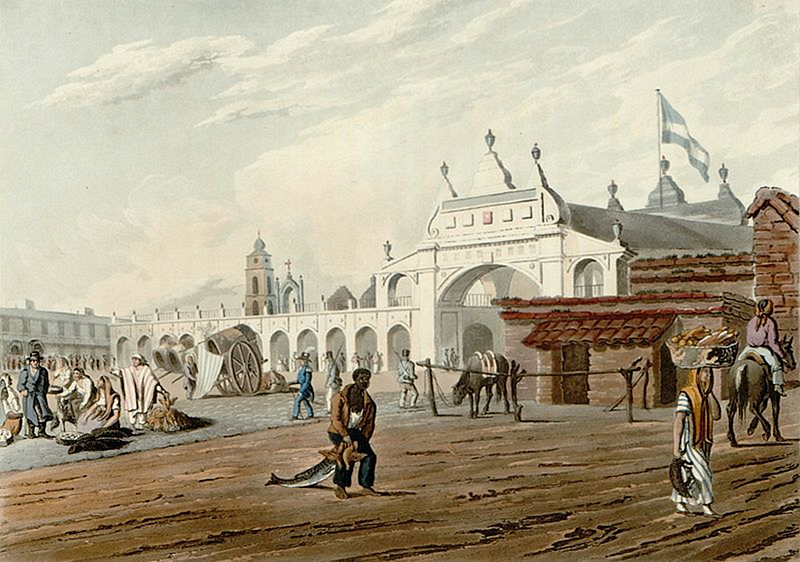
Emeric Essex Vidal — Buenos Aires City (1818)

From the upper floor of his home, Leonardo Buendía Pereyra de Castro gave himself over to contemplation. Each afternoon, as if fulfilling a private, unwavering ritual, he sat on a wooden chair beside the east-facing window that looked toward the port. With his back straight and his eyes fixed on the masts swaying like reeds along the river’s edge, he tried to trace the uncertain outline of Buenos Aires in his mind. A city not entirely his, but one he inhabited like someone who knows every fold, every crack in its skin.

In those minutes of stillness, as the late sun began to burn the rooftops and the cicadas raised their sharp chorus, something in Leonardo softened. As if rest, more than relief, was an act of invocation. From that height, the city revealed itself like a cartographic miniature — a mental map over which his debts, his dealings, and his discreet defeats were etched.

The visible world from his window echoed most vividly in the Recova and the Plaza Mayor, where neoclassical architecture, with its clean lines and rhythmic repetitions, imposed a symbolic center on the city’s chaotic life. There, at the intersection of civil life and commerce, Leonardo had established his shop two decades earlier. The storefront was plain but sturdy. Between a mule yard and a pulpería offering warm cane liquor and card games, his shop remained open from sunrise until the bells of the Cabildo rang in the fall of night.

Bundles of rue, mint, and basil hung in the doorway, drying in the heat of the day. Each morning before opening, Leonardo lit a candle to Saint Joseph and reviewed his ledgers, bound in green covers. The handwriting was spare, unadorned, but exact. Every word inscribed was a trace of his presence in this world of barter and silences.

Framed by the shop’s archway, he watched the city’s inhabitants come and go: burdened donkeys crossing the square, riders weaving through vendors, women with lifted skirts hurrying through their purchases — and always at the center, the obelisk of 1811, a monument to a will for order that never quite took hold. Leonardo recognized himself in that methodical chaos, like one of those background figures in old engravings, caught between the shadow of the eaves and the light filtering through the colonnades.

In his memory, everything intertwined with an image he had once seen in a foreigner’s illustration: a water cart drawn by oxen, descending a sloped street, the city rising in the background, towers pointing skyward. That image, captured by Emeric Essex Vidal, felt like an extension of his own afternoons. The wooden barrel shuddering on its axle, the wheels creaking, the driver’s sharp gesture, the resigned gaze of the animals. That was Buenos Aires — not in its monuments, but in that simple, repeated act of carrying murky water from the river to the city’s thirst.

For the city was not only lime and stone, but a daily choreography of laboring bodies. The voices of street vendors filled the corners: “Fresh fish! Tallow candles! Hemp ropes!” Life wove itself between the murmur of the market, the groaning of carts, the slap of sandals on uneven cobblestones. Leonardo observed it all as if mentally painting a canvas. He knew the city’s palette was made of dust, sweat, and memory.

He was a merchant, yes — but also a sharp observer. He could spot deceit in a glance, feel a future favor in the firmness of a handshake. He had the habit of noting every gesture, every phrase, in a black notebook — the same one that had accompanied him since his first arrival. He kept it beside a short Toledo steel dagger and an ebony-bead rosary.

At salons and evening gatherings, while others debated the uprisings in Upper Peru or the cost of sugar, he listened. He made mental notes of names, kinships, favors owed. He sent ciphered letters to Cádiz, received discreet parcels from Colonia, struck pacts with priests and widows, with captains and oarsmen.

At nightfall, returning along streets where the lanterns flickered like oil-fed stars, he thought of the city as a living being. Buenos Aires stood on a threshold — neither a glorious viceroyalty nor a fledgling republic, neither a poor village nor a modern city. It was, rather, a frontier between the old and the possible.

And Leonardo — who had seen it from above, walked it with his feet, bartered within it through words and gestures — knew it was not built with stones or laws, but with names, with debts, with silences. For every deal struck in shadow held more weight than a decree. And every glance, every gesture, formed part of the invisible foundation of that city which, though it did not yet seem so, was also his.

5

Chapter IV — A Marriage of Names and Silences

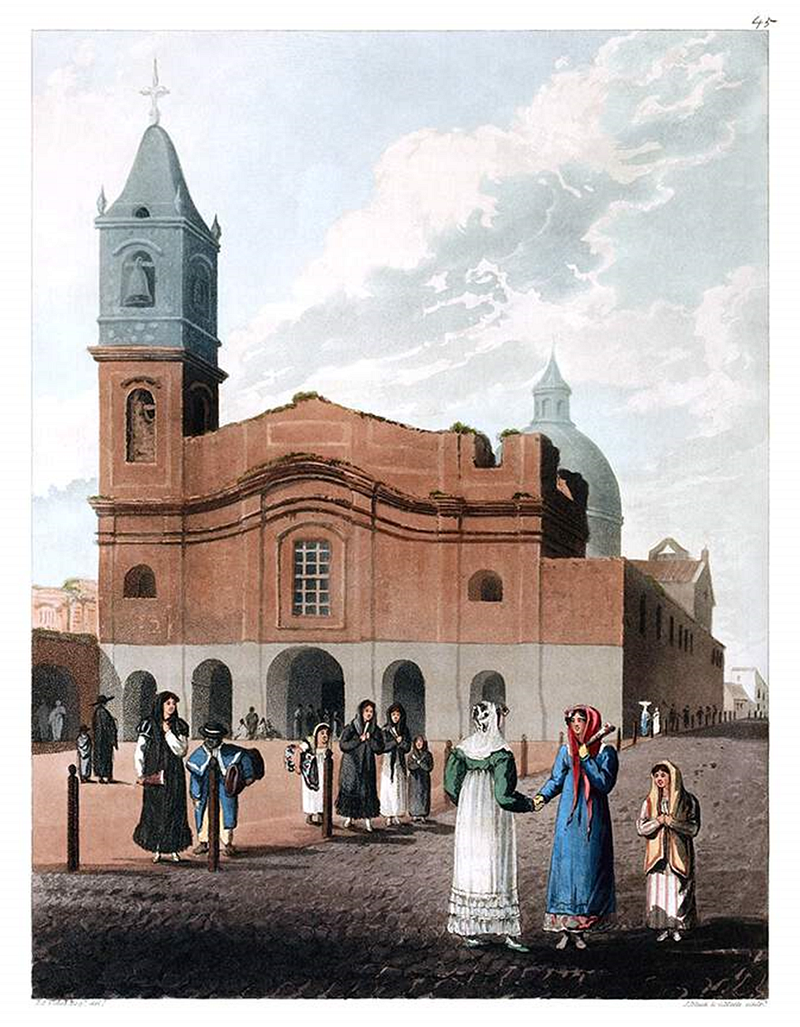
“The Church of Santo Domingo.” Hand-colored aquatint by Emeric Essex Vidal (1818).

When the dusty streets of Buenos Aires were as familiar to Leonardo as the lines on his own hands, and when the bells of Santo Domingo marked the hours of his business as faithfully as they marked the hours of his prayers, he understood it was time to raise his gaze from the ledger and seek a purpose not measured in coins or bales of goods.

It was in a sunlit courtyard, tiled and fragrant with orange blossoms, that he first saw María Mauricia — the daughter of Don Felipe Filiberto de Arguibel. She held a rosary tangled in her fingers and wore the solemn look of those who carry the weight of a name. She crossed the patio with a jug balanced on her hip, a strand of hair pasted to her forehead by the summer heat, while the air filled with the song of crickets and the sharp scent of fallen lemons crushed into the earth.

The daughters of good families walked with short steps and downcast eyes, fully aware that their futures were decided at tables where men spoke of shipments, casks of wine, and the price of silver from Potosí. They knew that a well-arranged marriage was their only gateway to life beyond the home, and that the alternative — for those lacking paternal favor — was reclusion behind the high walls of a convent, where time was measured by the murmur of prayers and the tolling of bells.

On Sunday mornings, the sidewalk in front of Santo Domingo transformed into a kind of ceremonial stage where social hierarchies, family expectations, and the silences imposed by decorum played out with almost choreographed ease. In the shadow of the unfinished church tower, mothers — draped in black mantillas, rosaries in hand and hearts tense with hope — whispered about their daughters’ futures. Gestures were restrained, words were scarce, but intentions clear: every exchange of glances with a young merchant or a military officer carried the weight of a possible union.

The church’s portico became a symbolic marketplace, where virtue, name, and lineage circulated like precious goods.

María Mauricia, her hands delicate as the lace on her dress and her voice always half-muted, followed her mother’s steps without protest. From childhood, she had been taught that a father’s command outweighed any personal longing, and that the family name — that silent and invisible inheritance — must be guarded like a family heirloom locked in a sealed chest. Don Felipe, her father, never raised his voice, but his decisions held the weight of stone. His authority was as firm as the church walls, and his will engraved itself into his daughter’s life like an unbroken path. She understood that, in that corner of time, love must resemble an agreement more than a flame, and that her future would be sealed — not by devotion at the altar, but by obedience.

Leonardo, solemn in gaze and measured in speech, asked for her hand one morning as the crowing of the rooster mixed with the bells of the church. He offered a simple ring and the promise of multiplying the family’s wealth with every ship that crossed the ocean. Don Felipe, stern-faced and sharp-eyed, accepted with a firm handshake — a gesture that sealed a pact of land and cargo, family alliances, and privileges before the Consulate.

They were married in that thick-walled church, where the scent of incense mingled with wax and human sweat. A priest in a worn cassock laid his hands upon them and blessed a union that bound more than two lives: it wove together families, fortunes, and future generations. At the altar, María Mauricia kept her eyes lowered, rosary clenched in her fingers, while the candlelight reflected golden flickers in the tears that hung from her lashes. Even then, she understood that marriage was also destiny — and that each chime of the church bell echoed like bronze over the history of a family rooting itself deep into the damp soil of Buenos Aires.

On the heavy, humid nights of viceregal Buenos Aires, when moisture climbed the adobe walls and the cicadas’ song merged with the river wind’s moan, Leonardo walked alone through the galleries of his home, letting the damp bricks cool the soles of his feet. Outside, the city was slowly cloaked in shadow, and from the dusty alleyways came the rhythmic, ancestral cry of the lamplighter.

It was a rough, steady voice, often sung by Black men — some freed, some enslaved — who roamed the city’s grid with a ladder on their shoulders, a flame in their hand, and a solemn dignity in their step.

In the backyards of the pulperías, barrels of water stood beside skins of wine, waiting for dawn and the hustle of the cart drivers. Night was not emptiness then; it was a different rhythm of the city’s breath.

Leonardo, however, was not thinking of the rituals of the city. His mind, tethered to memory, traveled back to Vigo — to the port where, as a boy, he had learned both to fear and to love the sea, where salt and wind shaped men’s faces with the same determination as promises made beneath stormy skies.

He had sworn then never to die poor in a foreign land. So each night he stepped into the courtyard and looked up at the stars flickering above the church dome, he made himself a new promise: that each of those lights would reflect upon a tree planted by his own hand, on land cleared in the open pampas, on a head of cattle branded with his own name. For Leonardo Buendía Pereyra de Castro had not crossed the ocean to languish behind brick walls and shadows — but to conquer the plains with the stubbornness of one who knows that every step in the mud leaves a mark that neither rain nor wind can ever erase.

6

Chapter V — Fever, Inheritance, and the Birth of a Lineage

The viceroyalty grew with the haste of a child stretching overnight, and its capital filled with merchants who spoke of Cádiz and Seville, of the price of flour and tallow, of the quality of wrought silver and of the contraband that slipped ashore from ships with flags blurred by salt. They said among themselves that King Charles had opened trade to bring prosperity, but in the taverns it was whispered that it served only to fill the pockets of those who lived behind the high doors of the Cabildo.

When Viceroy Pedro Melo de Portugal named him ensign of the ninth cavalry militia company, Leonardo put on the uniform with the same composure with which he counted the coins from each transaction, and mounted his horse with the bearing of one who knew that the land beneath his boots would one day be his. The drums echoed through the dusty streets as the militias lined up for parades, their sabers gleaming in the sun, their boots sinking deep into the mud. Each time the drums rolled, Leonardo raised his eyes to the horizon, and in the reflection of steel he saw endless fields, where the tall grass swayed like a sea in the wind, waiting for someone to found an estate that would bear his name.

For a time, everything seemed to advance as expected: military rank strengthened his social position, alliances sealed in commerce and politics opened paths in a city becoming urban through cries, hauling, and ceremony, and the name Buendía Pereyra de Castro began to be spoken with a touch of deference in the colonial courtyards. Leonardo attended mass, signed contracts with a firm and careful hand, and walked the streets with the confidence of one who believed the future to be the logical extension of his will.

But the city — with its humid air, stagnant waters, and streets that turned to mire after each rainfall — also imposed its law upon the body, and even men who bring with them the will of the sea can be overtaken by the frailty of flesh. Time, which had until then seemed his patient ally, began to remind him that no body can defy the laws of sun and fever.

So it was that, a few years after the wedding, while the bells rang the Angelus and carts laden with charqui raised dust in the streets of Buenos Aires, Leonardo began to feel a fatigue that settled into his bones like a silent guest. First came the fevers, rising with the midday sun and leaving his body drenched, his hands trembling as he lifted his cup of wine. Then came the pain in his entrails, twisting him awake at dawn with cold sweats and the taste of bile rising in his throat as he clutched the edge of his bed.

María Mauricia walked the galleries with the rosary in her hands, turning bead after bead while the candles burned down with a faint crackle, and with each prayer she thought of her sister Teodora’s letters, speaking of her husband, Juan Ignacio Ezcurra, and of the daughter soon to be born — Encarnación — a promise of future in a world that seemed to wither in the heat. Outside, mosquitoes hovered over the puddles left by summer rains, carrying fevers from the north, while inside the house, doctors with disheveled beards and glass jars of dark liquids prescribed camphor syrups, bitter infusions, and turpentine brews to calm Leonardo’s tremors. He remained in the gallery staring at the sky, fever glowing in his eyes, sweat running down his forehead like a reminder of the body’s fragility in these lands of heat and dust, where even hope seemed suspended in the air, mixed with the distant rumble of militia drums that guarded the city.

The doctors spoke of dysentery and intermittent fevers, and some advised a journey to the countryside, where clean air and the murmur of streams might restore the strength that the city had drained. Leonardo, who mounted his horse with growing difficulty for the parades of the ninth company, understood that the strength remaining to him was not meant for drills or salvos of powder on festal days. With the composure of one making a final decision, he presented his resignation for reasons of health to the viceroy, handing over his sword and uniform with the same dignity with which he had laced his boots years earlier, when he swore loyalty to the crown.

Around the same time, Don Felipe Filiberto de Arguibel, the father-in-law who had held the reins of family trade with a firm hand, breathed his last upon rough sheets, while the bells tolled a grave lament across the streets of Buenos Aires. The corridors of the house filled with kin dressed in black, rosaries in hand and eyes cast down, while the scent of wax and incense mingled with the sharp odor of aguardiente passed from hand to hand to steady grieving spirits. María Mauricia, her hair covered with a dark kerchief, received without tears the news that part of the inheritance was hers, for such was the law of the kingdom and the will of the father, who had guarded each peso and real with the care of one who knows that a name must stand firm as oak, even after death.

Among deeds of properties and chests of silver and copper coins, María Mauricia found the record of a house in the city and a capital sufficient for Leonardo to fulfill the promise he had made to himself the night he landed in Buenos Aires: to own land, to raise cattle, to build an estate that would carry his name to the farthest edge of the pampas. That discovery was more than an act of domestic administration; it was a key that unlocked the path toward a longed-for future, a quiet yet decisive way of accompanying her husband’s desire and ensuring that the surname she now bore would take root in the soil.

In 1799, when the spring rains left puddles reflecting the flight of lapwings and the wind carried the scent of new grass, Leonardo purchased an estancia in the district of La Matanza. It was a land stretching with the immensity of a green sea, dotted with ombú trees and crossed by the river that gave the place its name. Cattle grazed there calmly, unaware of the hand that would one day brand them with hot iron, while the crowing of roosters awoke the peons who slept in rooms of adobe and thatch.

The nights in La Matanza filled with the song of crickets and the creaking of branches in the southern wind. Leonardo walked the fields, his boots sinking into damp soil, gazing at the star-covered sky and thinking that each point of light was a reminder of how far he had come from the coast of Vigo. María Mauricia walked beside him, her hands resting upon the womb where already beat the blood of those who would continue the lineage, her eyes reflecting the distant lanterns hanging from the estancia’s rafters, like fireflies marking the edges of their world.

There would be twelve in all, born one by one amid seasons of abundance and drought, amid wars passing along the roads and plagues lurking in the wells. Each child was received with the quiet hope of those who know that in these lands, to be born is to resist. Not all would reach adulthood: some died before they could walk, others were taken by fever before they could read, and others — the strongest or the most fortunate — would meet their fate on the battlefield, in a portside workshop, in a convent, in a pulpería, or behind a counter, where their parents’ inherited dreams mingled with the limits set by time.

The lives of each were marked by the weight of their name and by the narrowness of opportunity, by the command of duty and the wounds of unspoken desire. The daughters learned to embroider before they learned to write, and the sons to ride before they could deliver speeches. Some adapted to the new order rising amid revolutions and unstable constitutions, while others clung with melancholy to the world unraveling with the century. Yet all, in their own way, carried in their skin the memory of that open land, of that house with its central well, of that founding marriage which, unknowingly, had traced the intimate map of a lineage destined to endure in oral tales, in faded papers, and in silences that would outlast their names.