José Hernández’s “El gaucho Martín Fierro” is a classic epic poem, divided into two parts, published in 1872 and 1879. It tells the story of Martín Fierro, a rural Argentine man, who is forced to flee his home and live as a fugitive due to a draft(forced recruitment for war) it describes the injustice and mistreatment of the gauchos by society and government, and also it celebrates their way of life and values. This poem is widely considered one of the most significant literary works in Argentina and is deeply ingrained in the country’s cultural heritage.
In this presentation, I will be providing a detailed explanation of the first part of the poem, referred to as “The departure of Martín Fierro.” The complete poem can be accessed through the following link:
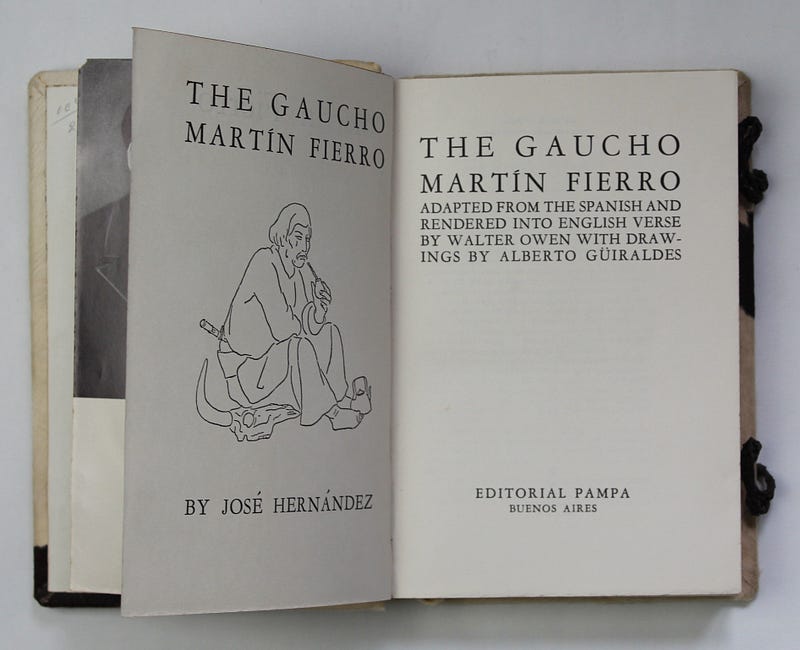
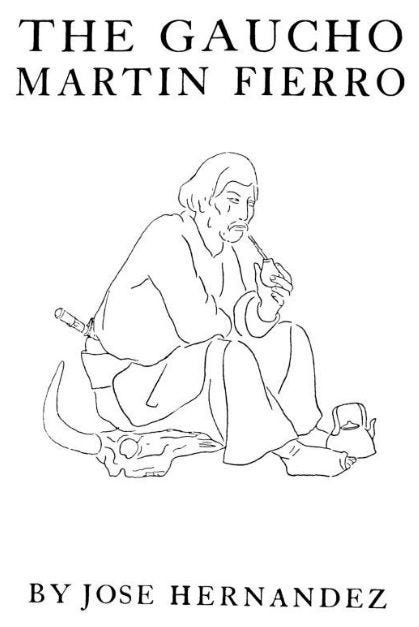
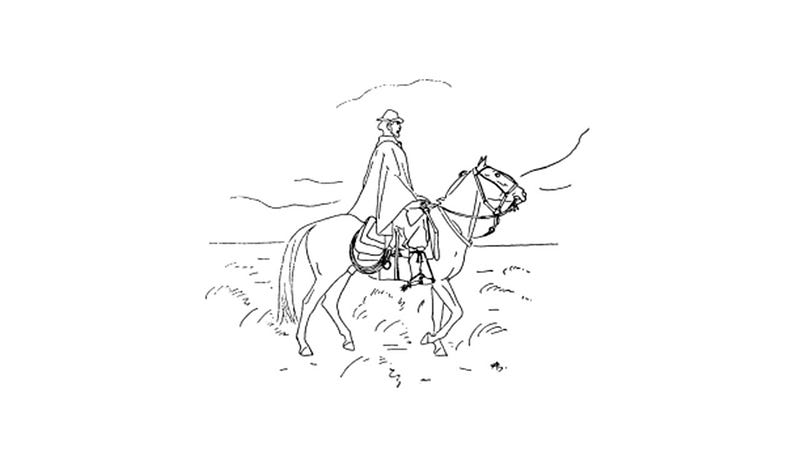
Adapted from the spanish and rendered into english verse by walter owen with drawings by Alberto Guiraldez
The second canto completes the sense of the narrative that Fierro will make of his life. It is not about singing, as in the case of “the lonely bird,” only to seek consolation, but also to transmit knowledge.
Fierro has a much more elemental wisdom than that of any literate man, it is the wisdom of one who has suffered, because, “nothing teaches as much as suffering and crying.”
Almost all of the stanzas of this canto confront the memory of an idyllic past, in which the gaucho had work, a small farm and family, with the present of enunciation in which the poor man spends his life running from authority, as we read in one of his verses.”
There was a time when I knew this land
As the gaucho’s own domain;
With children and wife, he had joy in life,
And law was kept by the ready knife
Far better than now; alas, no more
That time shall come again.
In the penultimate stanza, the way in which Fierro’s personal misfortune is linked to that of the rest of the peasants is announced. It all starts with the draft or forced recruitment for war:
And there God knows, your share of woes
With a vengeance you begin;
In a cell you’ll stay for many a day,
Till your turn comes round, and yea, or nay,
They draft you off to a frontier post, —
Thank God you’ve saved your skin!
And in the last stanza we read:
It was there, I own, that I learned to groan,
And thus my griefs began,
In other songs, if you’ll bear with me,
I’ll tell you the tale of my misery;
From the law’s grim trap not the Saints of heaven
Have ever saved a man.
2
The first canto
English versión of José Hernández’s poem —
José Hernández’s “El gaucho Martín Fierro” is a classic epic poem, divided into two parts, published in 1872 and 1879. It tells the story of Martín Fierro, a rural Argentine man, who is forced to flee his home and live as a fugitive due to a draft(forced recruitment for war) it describes the injustice and mistreatment of the gauchos by society and government, and also it celebrates their way of life and values. This poem is widely considered one of the most significant literary works in Argentina and is deeply ingrained in the country’s cultural heritage.
In this presentation, I will be providing a detailed explanation of the first part of the poem, referred to as “The departure of Martín Fierro.” The complete poem can be accessed through the following link:
Adapted from the spanish and rendered into english verse by walter owen with drawings by Alberto Guiraldez
The first canto
In the opening canto, there are several central themes. The first is the introduction of the character Fierro, who expresses that he sings to find comfort for “an extraordinary pain” {“una pena extraordinaria”} and views this verse as a means of communication, singing for others and positioning us, his audience, as confidants. He also demands our attention.
SIT me here to sing my song
To the beat of my old guitar;
For the man whose life is a bitter cup,
With a song may yet his heart lift up,
As the lonely bird on the leafless tree,
That sings ’neath the gloaming star.
Then gather around and hearken well
Toa gaucho’s doleful story,
In whose veins the blood of the Pampas runs,
Who married a wife and begat him sons,
Yet who nevertheless is held by some
As a bandit grim and gory.
Additionally, he warns us that the story he has to tell is that of a man who has fallen into disgrace, as conveyed in the final two stanzas of the opening canto:
SIT me here to sing my song
To the beat of my old guitar.
{Aquí me pongo a cantar,
al compás de la vigüela.}
The use of octosyllabic verse is a characteristic of the gauchesque “payada”, a style popular among contemporary poets, as seen in the line “Tell me, partner.”
Despite not being a gaucho himself, José Hernández, like other authors of what is known as gauchesque poetry, intentionally incorporated gaucho language and the use of octosyllabic verse into his work. Additionally, it also uses another common feature of payadas — the invocation of saints — which can be seen clearly in the first verse.
Come down ye Saints that have helped me
In many a perilous pass;
For my tongue is tied and my eyes grow dim,
And the man that calis, God answers him,
And brings him home to his own roof-tree,
Out of many a deep morass.
This is very characteristic of the gauchesque payada, as is also the gesture of self-affirmation when he says:
For me the whole great world is small,
Believe me, my heart can hold it all;
The snake strikes not at my passing foot,
The sun burns not my head.
Si te ha gustado este comentario y quieres hacerme un pequeño regalo, ingresa a tu banca en línea o billetera virtual y deposita lo que consideras vale este tiempo a mi alias gonza.darrigrand en el Banco de la Provincia de Buenos Aires, Argentina.
If you enjoyed this comment and would like to give me a small gift, please log into your online bank or virtual wallet and deposit what you consider this time is worth to my alias gonza.darrigrand at Banco de la Provincia de Buenos Aires, Argentina.
3
The Third Canto
English versión of José Hernández’s poem —
José Hernández’s “El gaucho Martín Fierro” is a classic epic poem, divided into two parts, published in 1872 and 1879. It tells the story of Martín Fierro, a rural Argentine man, who is forced to flee his home and live as a fugitive due to a draft(forced recruitment for war) it describes the injustice and mistreatment of the gauchos by society and government, and also it celebrates their way of life and values. This poem is widely considered one of the most significant literary works in Argentina and is deeply ingrained in the country’s cultural heritage.
In this presentation, I will be providing a detailed explanation of the first part of the poem, referred to as “The departure of Martín Fierro.” The complete poem can be accessed through the following link:
Adapted from the spanish and rendered into english verse by walter owen with drawings by Alberto Guiraldez
From this canto, Fierro begins to tell his own story. The poem will begin to reveal its narrative character, something that is characteristic of Gaucho poetry as a literary genre.
Ah, happy was I ’neath my ‘rancho’s’ roof,
As the bird in its feathered nest;
My heart rose up with a father’s pride,
As I watched my boys with the rangers ride;
Alas, of all by an evil chance,
In a day I was dispossessed.
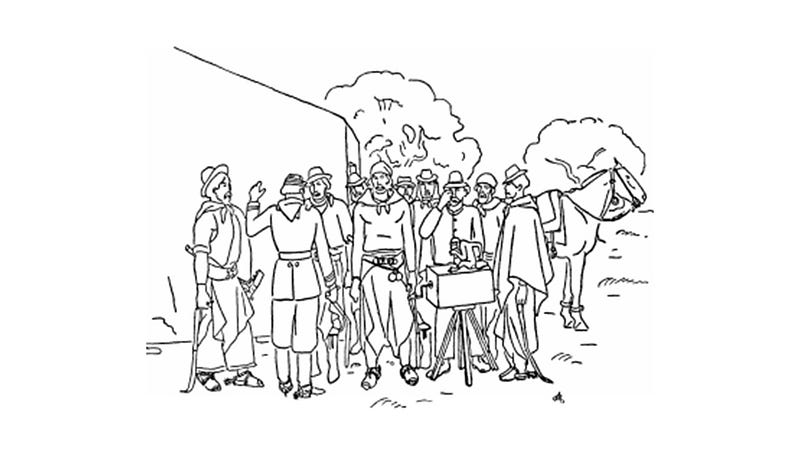
Without ever abandoning octosyllabic verse, we begin to recognize episodes or small narrative units. The first of these episodes is the draft, which surprises Fierro at the ‘pulpería’ while he was having fun with other gauchos, at a dance, and which determines the beginning of his misfortune.
And once at a merry gathering,
I was warm and going strong,
When all of a sudden there and then,
The Justice came with a troop of men,
And the party carne to a sudden end;
For they took the lot along.
The draft, along with the account of life in the fort, will serve for Fierro to denounce the injustice and arbitrariness of the State as well as its ineffectiveness for border protection.
Sarmiento in his Facundo also composes a portrait about the figure of the Justice of the Peace that in Hernandez’s poem determines the fall from grace of the gaucho Martin Fierro.
To finish with this third canto, we can point out the representation that the author of the work offers of two other historical actors: one is the immigrant and the other is the indian. On the immigrant, Hernandez points out his clumsiness and cowardice:
A gringo hurdy-gurdy man,
With a dancing monkey there,
Was doing his bit to help the fun;
They roped him too, though he tried to run;
A big soft-looking fellow was he, —
And he cried for sheer despair.
And an English digger of ditches too,
That had dodged the draft before,
By telling the Justice, I understand,
That he carne from Inca-la-Perra’ land, —
He took to his heels and got to the hills
By the skin of his teeth, no more.
“And so astride my ‘moro’ soon.”
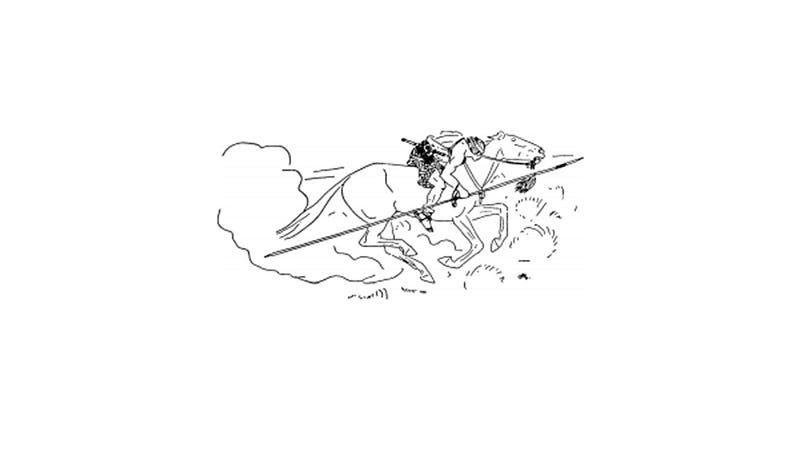
As for the Indian, in the first part of the poem, he recognizes his skill as a rider and his qualities for war. This representation that we read here will change in the second part of the poem.
From the outer wilds on his wiry horse
He takes the trackless way;
He eats the prairie, league on league,
He recks not hunger or fatigue;
The Indian and the ant — these two
Are busy night and day.
At handling the ‘bolas’ there’s nobody else
As the Indian so clever;
When you’re drawing off,& you think he’s through
He’ll send a chance shot after you,
And if it catches you, for sure,
It lays you out forever.
He’ll shift his lance to his bridle-grip, And stuff them back with his hand, and wheel, And be off like a lightning flash
4
The Fourth Canto
English versión of José Hernández’s poem —
José Hernández’s “El gaucho Martín Fierro” is a classic epic poem, divided into two parts, published in 1872 and 1879. It tells the story of Martín Fierro, a rural Argentine man, who is forced to flee his home and live as a fugitive due to a draft(forced recruitment for war) it describes the injustice and mistreatment of the gauchos by society and government, and also it celebrates their way of life and values. This poem is widely considered one of the most significant literary works in Argentina and is deeply ingrained in the country’s cultural heritage.
In this presentation, I will be providing a detailed explanation of the first part of the poem, referred to as “The departure of Martín Fierro.” The complete poem can be accessed through the following link:
Adapted from the spanish and rendered into english verse by walter owen with drawings by Alberto Guiraldez.
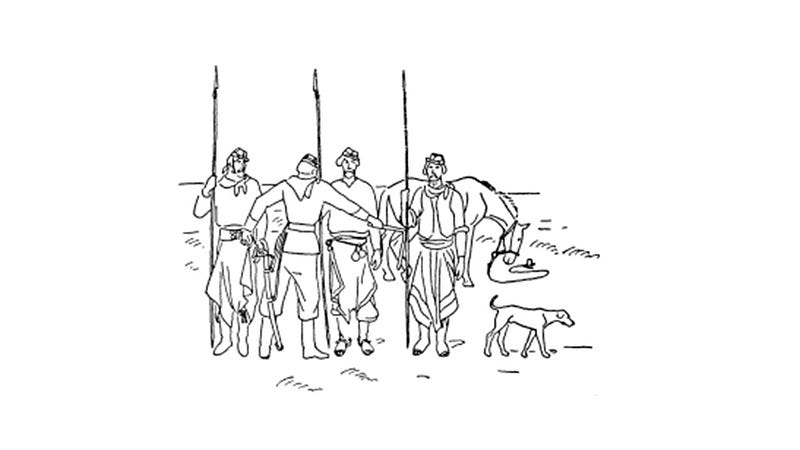
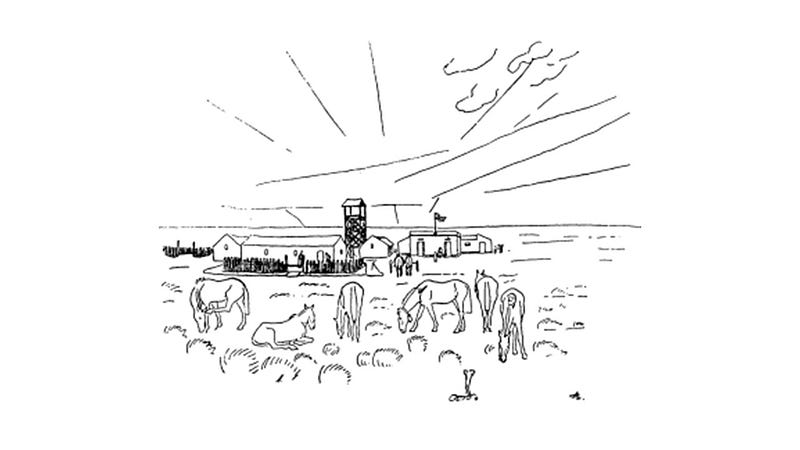
This canto delves into the desolate portrait of life in the fort where Fierro spends three years. Here, a key character in the campaign, the figure of the commander, stands out, representing, along with the Justice of the Peace, the power of the state in those parts.
I’ll nothing say about our pay,
For never a cent we smelt;
It kept far ahead like the Indian raid,
Nor even stayed for an ambuscade;
Like a hungry pack we hung on its track,
But we never got its pelt.
As part of their everyday life on the frontier, hunting, bartering, and monetary economy are the three alternatives that converge in this story, and together with the figures of the Justice of the Peace, the commander, the immigrants, and the Indian that Fierro has already mentioned, we meet the participation of a new character, the storekeeper {‘el pulpero’}, who stands out for his greed and complicity with the military authorities.
The Colonel’s bosom friend was he,
And a thundering barefaced thief.
He sold his goods at a sinful rate,
— Whenwe brought him feathers ’twasweight for weight
Of tobacco or ‘yerba’; — everyone knew
That he halved what he made with the Chief.
The gauchos who serve on the frontier are paid a pittance, and when the salary is distributed, there is the skilled storekeeper with his list of pawns.
Some took out the clothes they had in pawn,
Some drank to the Government,
And others found that what they drew
Just paid their bilis that were overdue;
In the end the bandit that sold the drinks
Remained with every cent.
During his stay in the cantonment, Fierro loses even his clothes and, what he most regrets in his soul, he loses his Moro horse (the “Outstanding Matucho” with which he won more silver than holy water in Ayacucho; “A horse in a hundred score, — At Ayacucho I made him run, And a pot of money for me he won” Canto III) at the hands of the commander.
On the other hand, when the sergeant of the fort warns the commander that Fierro is claiming his pay, he tells him that they were no longer the times of Rosas and that no one owed anything to anyone.
We must remember, on this occasion, that Juan Manuel de Rosas himself, before becoming governor of the Province of Buenos Aires, was a campaign commander. On this occasion, so as not to be thought of as a reckless gaucho, Fierro remains silent and although he suspects a trick, he says that “I pretend to be asleep although I’m half awake.” To close the interpretation of this canto, we must know that the commander, according to Domingo Faustino Sarmiento in chapter III of Facundo, is one of the faces of barbarism:
“The government of the cities is what gives the title of campaign commander; but as the city is weak in the countryside, without influence and without supporters, the government takes hold of the men who inspire the most fear to entrust them with this job, in order to have them in obedience, a well-known way of proceeding of all weak governments, and that they remove the evil of the present moment so that it occurs later in colossal dimensions.”
“El gaucho Martín Fierro” and “The Pay-Day”
On many occasions it is possible to compare and contrast several of the situations that José Hernández relates in this fourth song of “El gaucho Martín Fierro” with the experiences narrated by Walt Whitman in “The Pay-Day”.
In Whitman’s poem, he speaks of the life of soldiers during the American Civil War and their experiences on the battlefield. The poem describes hunting, bartering, and monetary economy as part of everyday life on the front, and mentions characters such as the Justice of the Peace, the commander, immigrants, and the Indian.
In “El gaucho Martín Fierro”, he speaks of the life of the gaucho Martín Fierro on the Argentine frontier and his experiences as a soldier and exile. The poem describes life in the fort where Martín Fierro spends three years and mentions characters such as the Justice of the Peace and the commander, who represent the power of the state in those parts.
Both poems speak of life on the frontier and mention characters who have authority and power in those contexts. However, while “The Pay-Day” focuses on the American Civil War and describes the life of soldiers during the conflict, “El gaucho Martín Fierro” focuses on the life of the gaucho Martín Fierro on the Argentine frontier and describes his experience as a soldier and exile.
5
The fifth canto
English versión of José Hernández’s poem —
José Hernández’s “El gaucho Martín Fierro” is a classic epic poem, divided into two parts, published in 1872 and 1879. It tells the story of Martín Fierro, a rural Argentine man, who is forced to flee his home and live as a fugitive due to a draft(forced recruitment for war) it describes the injustice and mistreatment of the gauchos by society and government, and also it celebrates their way of life and values. This poem is widely considered one of the most significant literary works in Argentina and is deeply ingrained in the country’s cultural heritage.
In this presentation, I will be providing a detailed explanation of the first part of the poem, referred to as “The departure of Martín Fierro.” The complete poem can be accessed through the following link:
Adapted from the spanish and rendered into english verse by walter owen with drawings by Alberto Guiraldez.
After three years in the fort, Fierro decides to desert. He then waits for the opportunity to do so.
Everything yonder is upside down,
Soldiers are turned into ‘peones’;
When the Indians come they cali them to arms,
But meanwhile they send them to work on the farms
And their army pay and their hire as well,
Is bagged by the Chief and his cronies.
The reason for fleeing is not only linked to the harsh living conditions to which he is subjected or the unjust punishments he receives, but also to the evidence that this state of affairs is irremediable. He has seen, as he himself says, “dirty business” and concludes that “the mess does not want to be fixed”. Here we read one of the most significant verses of the poem:
There’s many a Chief with herds and lands,
And soldiers instead of hired hands,
And many a dirty deal I’ve seen,
In spite of my ignorance.
The gaucho deduces that his freedom has been sacrificed to be transformed into cheap and free labor on the estates that the agro-export model organizes. The straw that breaks the camel’s back is a confrontation that Fierro has with an Italian immigrant who guards the entrance to the fort one night. The immigrant is drunk, doesn’t recognize him and shoots him.
In my life I’ll bet Til not forget
What happened to me that night
At the gate of the fort a raw recruit
Nearly did for me — the drunken brute! —
Though he propped himself up with his musket, yet
He could hardly stand upright.
He spoke so thick that no-one there
Could understand his lingo;
God knows where they could have found the man;
I doubt he was even a Christian;
A ‘papolitano’ he said he was, —
Which I take is a kind of gringo.
They had put him there as a sentinel, —
The drunken gringo beast, —
He was soused so well he could scarcely see,
And when I carne up he challenged me;
And the rumpus began when the fool took fright;
And I was the duck of the feast.
He yelled at me: ‘Quen vívore?’
And I answered: ‘Qué víboras!’
I could see him peering about in the dark;
‘Ha garto!’ he roared; and just for alark,
I said, ‘The only “lagarto” here,
Is yourself, you gringo ass.’
And on the spot — Christ save my soul!
I nearly went to glory;
I heard a click and I ducked my head,
And he missed me with half a pound of lead;
If he hadn’t been too drunk to aim,
I shouldn’t be telling the story.
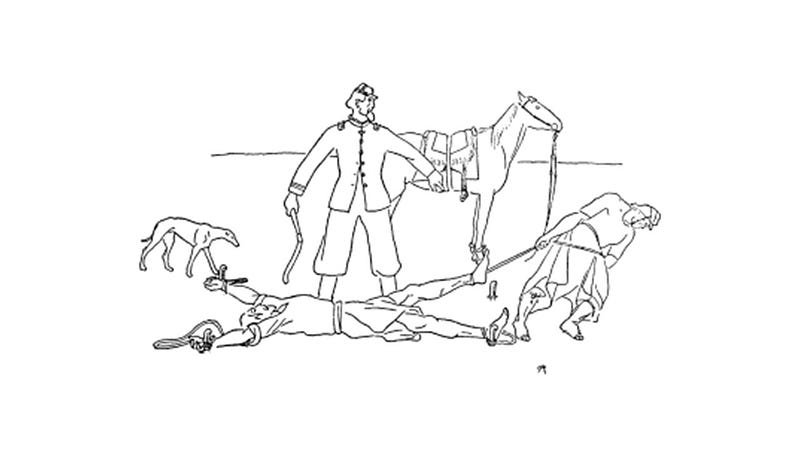
As a result of this, an incident begins that ends with Fierro punished and staked out.
Then to my hands and feet they tied
Four thongs of plaited hide.
They hauled and jerked till they gave me hell,
But they didn’t jerk out a single yell;
And all night long that gringo brute
With curse on curse I plied.
Then to my hands and feet they tied / Four thongs of plaited hide.
This episode with the Italian immigrant is another occasion in which Fierro reiterates his questioning of the figure of the gringo and also of the government’s action in sending immigrants to the border, a contradiction in that they don’t know how to saddle or hitch a horse, don’t know how to distinguish one animal from another, spend all their time drunk and suffer the heat.
These are the gringos that Sarmiento thought of in his civilizing and modernizing project, why does Hernandez insist on this negative characterization of immigrants?
6
The sixth canto
English versión of José Hernández’s poem —
José Hernández’s “El gaucho Martín Fierro” is a classic epic poem, divided into two parts, published in 1872 and 1879. It tells the story of Martín Fierro, a rural Argentine man, who is forced to flee his home and live as a fugitive due to a draft(forced recruitment for war) it describes the injustice and mistreatment of the gauchos by society and government, and also it celebrates their way of life and values. This poem is widely considered one of the most significant literary works in Argentina and is deeply ingrained in the country’s cultural heritage.
In this presentation, I will be providing a detailed explanation of the first part of the poem, referred to as “The departure of Martín Fierro.” The complete poem can be accessed through the following link:
Adapted from the spanish and rendered into english verse by walter owen with drawings by Alberto Guiraldez
When he deserts from the border, Fierro technically becomes a criminal.
Twas three long years since I’d left my home,
Three years of woe and care;
I was scarred with sorrow, want, and pain,
But ready to try my luck again,
And as the ‘peludo’ makes for its hole,
I headed for my lair.
Our character waits and hopes for a raid to happen so that he can escape in the disorder and confusion. But, he is faced with the organization of a large-scale and surprise punitive expedition against the Indians, with cannons, a large part of the army, and the presence of the War Minister: “a minister or whatever they called him, Don Ganza,” which derails his initial plans.
If in Canto III we have the opportunity to read the only precise geographical reference in which Fierro moved, now we know that the story takes place between 1868 and 1874, a period in which Martín José Mariano Dolores del Corazón de Jesús de Gainza was Minister of War and Navy during the presidency of Domingo Faustino Sarmiento.
With his original plans foiled, Fierro takes advantage of another opportunity and, one night when he sees the “Chief and the Justice of the Peace” playing and drinking together, he doesn’t wait any longer and escapes.
One night when the Justice and the Chief
Were close in confabulation,
Passing a bottle to and fro,
I thought I’d risk a chance, and so —
On a horse I caught, like a trail of smoke,
I faded out from the station.
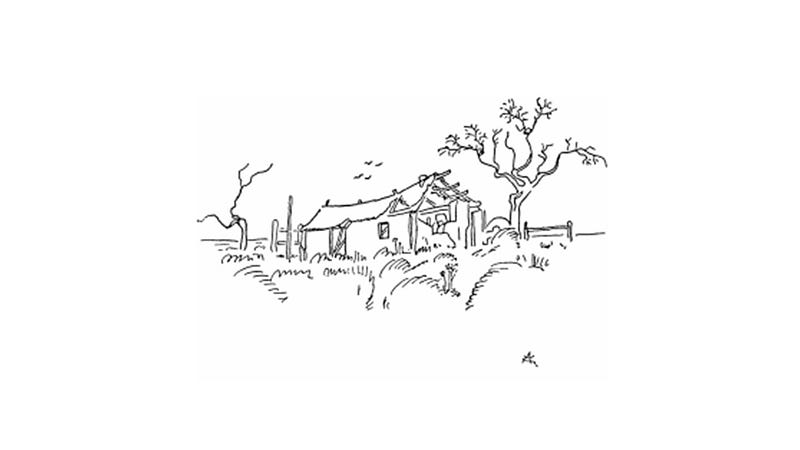
He knows now that he has reasons to avoid justice and that he will have to spend the rest of his days as a ruthless gaucho. Nevertheless, and perhaps running some risks, he decides to return to his village with the hope of seeing his wife and children again. The situation that Fierro finds himself in is desolate. There is no family, no home, no estate. He has lost everything, perhaps irrevocably, because of the forced recruitment he has been a victim of.
Only a few bare poles were left,
And the thatch and nothing more;
Christ knows it was a mournful sight,
It withered my heart up like a blight,
And there in the wreck of my ruined home,
To be revenged I swore.
Fierro, already aware that he was being pursued, decides to “be worse than a beast,” this is the “Breaking Bad” moment in the story, and this act of despair, with this unleashed resentment, will explain some of his immediate actions. On the other hand, the loss of his children will generate in us, his readers-spectators, the eventual expectation of a family reunion.
The only sound was the howl of a cat, That had stayed by the ruined shack.
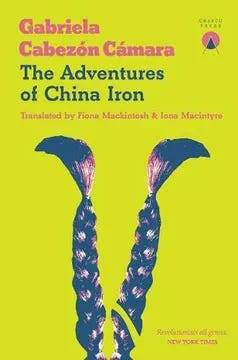
What happened to Fierro’s wife? This question, which focuses on that poor woman who barely reaches the status of a character, is the foundation of Gabriela Cabezón Cámara’s great novel.
This author will give voice to Fierro’s wife in the same way that José Hernández did with the gaucho, not only to conjecturally restore a fragment of history, but to tell the story of a woman who discovers herself, and with this, an ecstatic world of senses, shapes, and colors.